The setting

About the world

Four centuries ago the sea rose and never fell again. What's left of the old world is scattered islands in an endless ocean called the Wide. This is who lives there, who holds it, who thinks they hold it, and what nobody can explain.

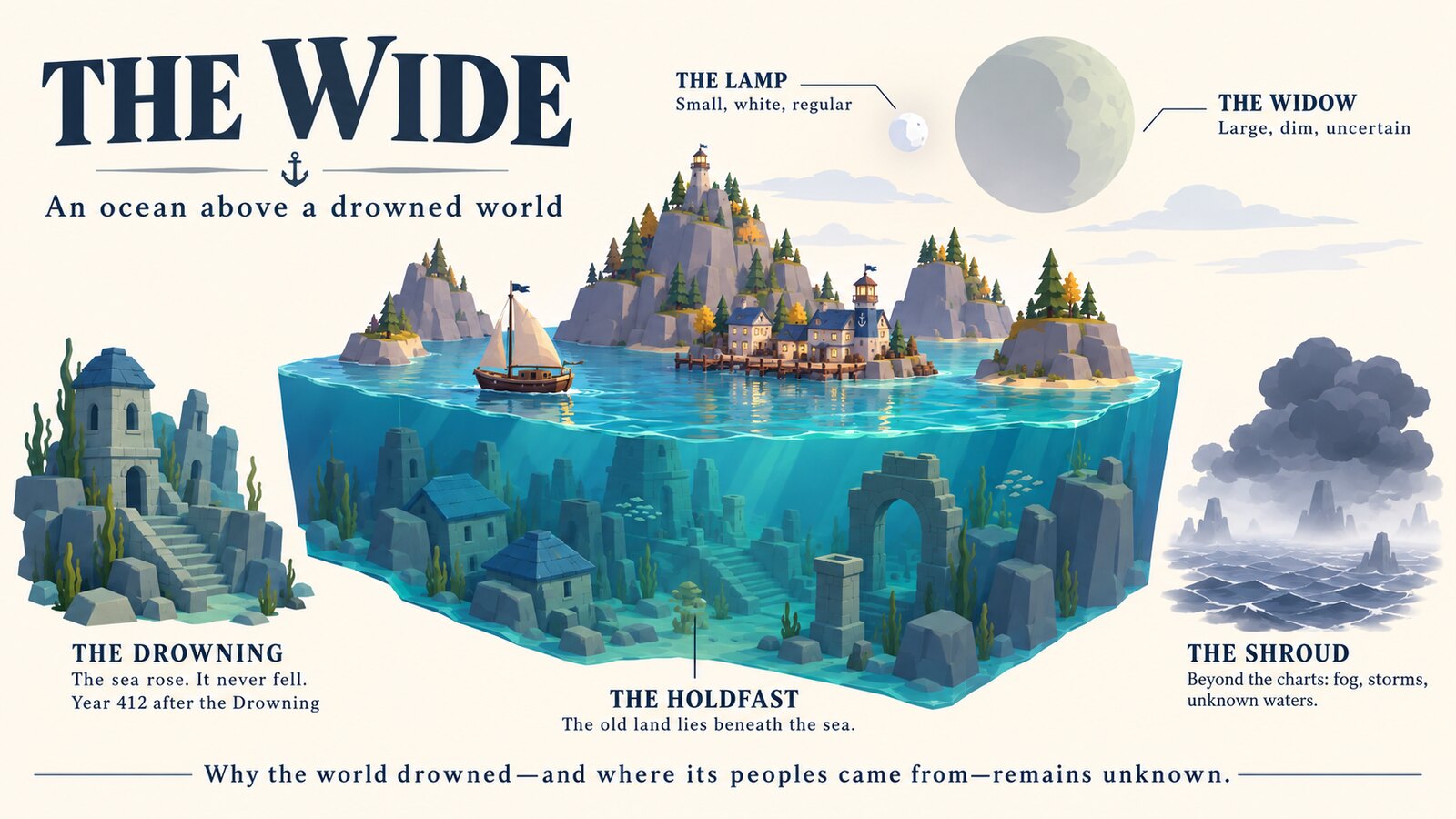
A cutaway of the Wide: islands and a harbour town on the surface, the towers and streets of the drowned Ommaruun beneath, the two moons above, and the storm belt of the Shroud at the edge
Concept art: an ocean above a drowned world.

The Wide

The whole world is one ocean with islands in it. People call it the Wide. Nobody has sailed round it and nobody knows how big it is. “There is only the Wide” is a proverb and a shrug.

This is not Earth, and there is no mainland past the edge of the chart. The known waters are the islands charted from three capitals. Beyond them lies the Shroud, a belt of fog banks and storms, and water nobody has mapped. Crews won't sail into it.

Salt and fish are plentiful. Fresh water, soil and timber are rare, and worth fighting over. A town's rain-cistern is often its strongest building.

Light isn't rare. Every lamp on the Wide is a glass case of sea-water with a glim in it: a small jellyfish that glows, lives for centuries on a pinch of lampmeal a day, and sulks if nobody scrubs its glass. A few of the first glims ever kept still shine in the oldest lighthouses, and the Old Tide has a book with every lighthouse glim's family in it. Fire is for warmth and cooking. Nobody hunts whales: the great whales swim the open sea far from shore, and the Wide leaves them alone.

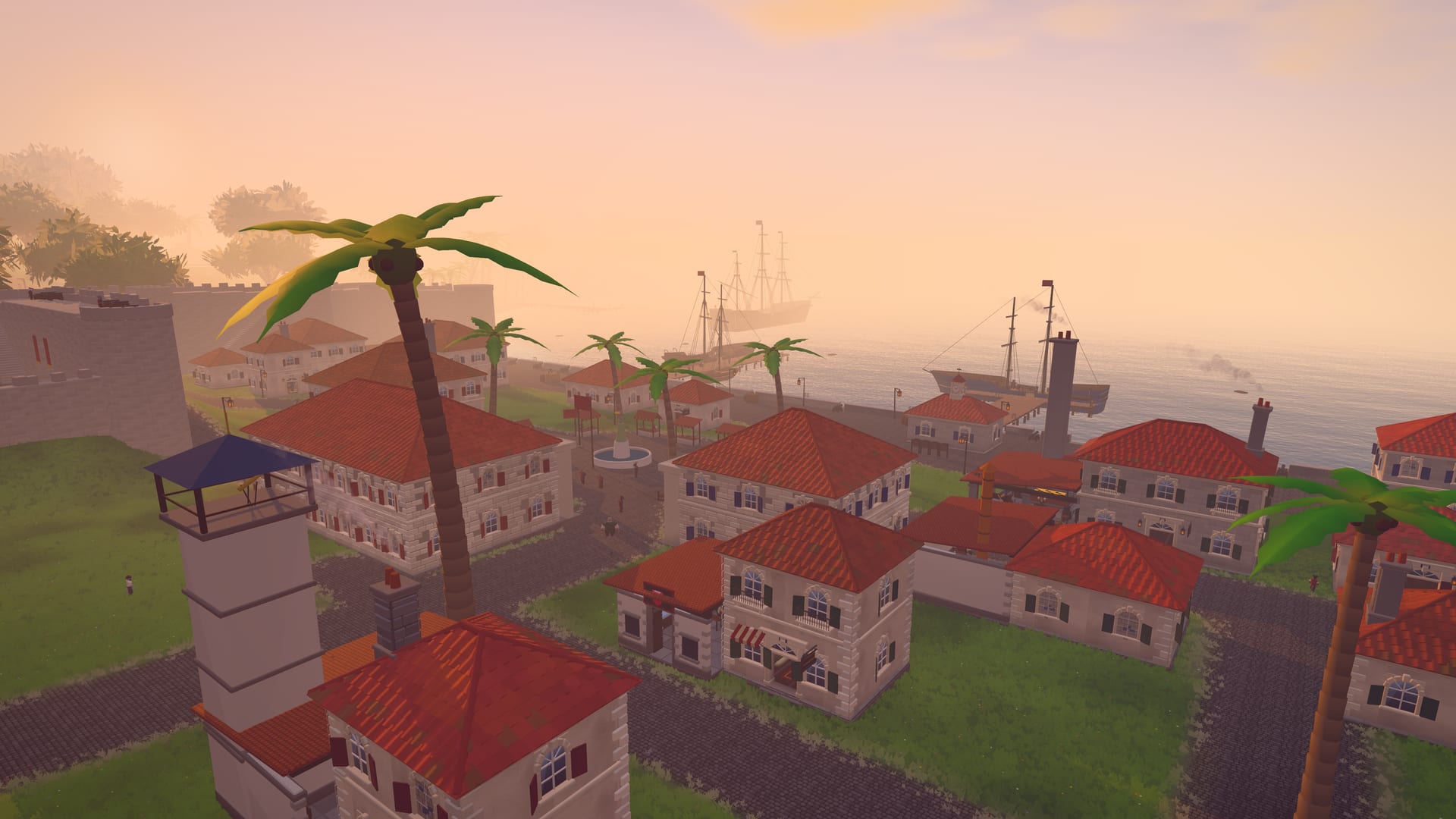
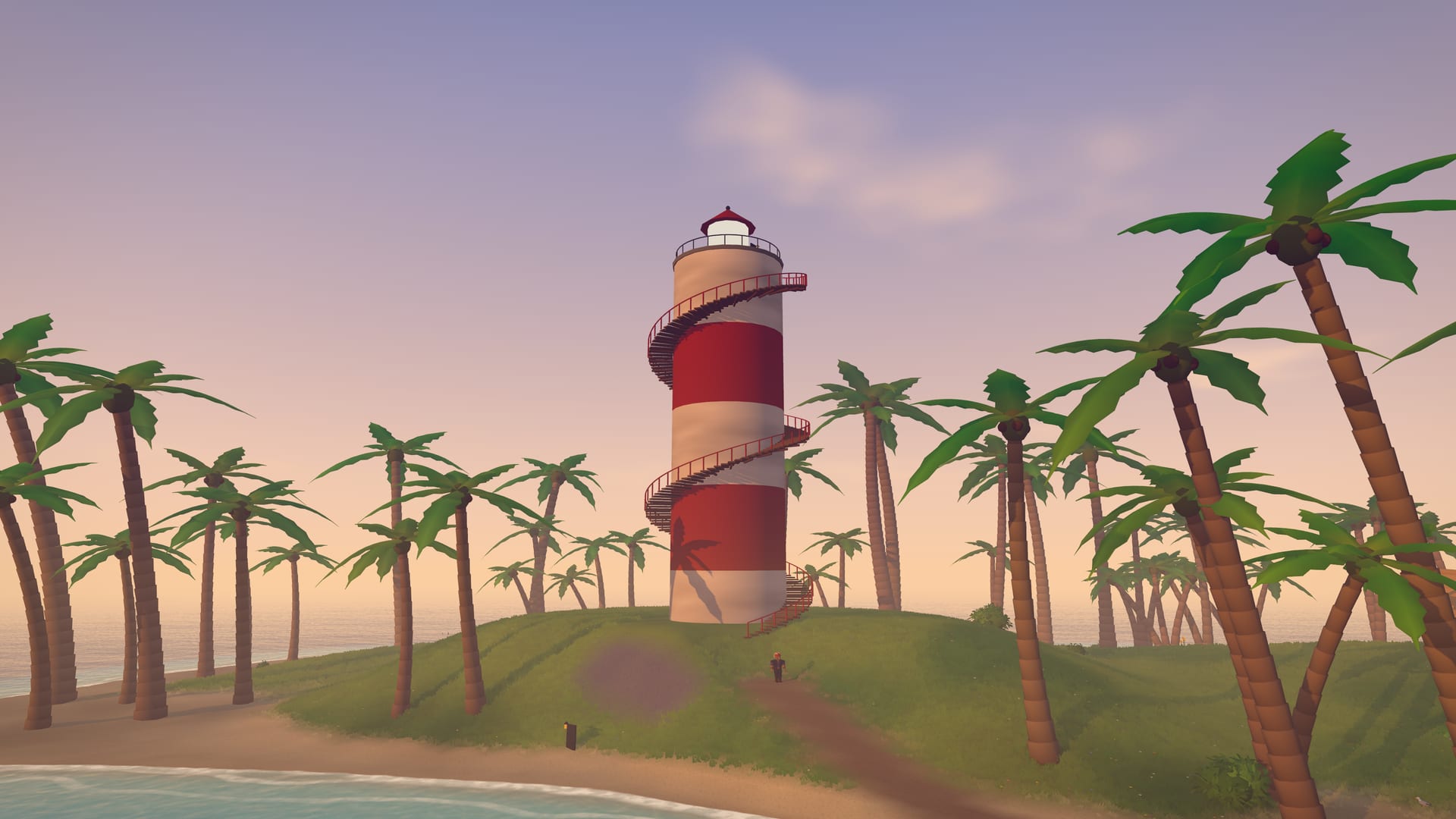
Ilvona Light
Ilvona Light.
PlentifulSalt and fish
RareFresh water, soil, timber
LampsGlims in glass
Past the chartThe Shroud

The Drowning

Many generations ago the sea rose. People call it the Drowning, and they count their years from it. This is the 412th.

Before it there was one great land, which the old songs call Ommaruun: kingdoms, rivers, forests and roads. Today's islands were its mountains and high downs. The rest is under the sea. You can still find stairs that run down into the water, drowned harbours, and towers standing in the shallows.

Nobody agrees on why it happened, or how long it took: a night, or forty years. Every power tells the story its own way, and each telling happens to justify what that power does.

Everyone agrees on three things:

  • The land drowned. The ruins prove it.
  • The survivors reached the peaks and the boats, and everyone alive descends from them.
  • The sea has never gone back down.
WhoTheir storyWhat it justifies
The CrownThe Judgement. The waters took the unworthy and spared those who held the last mountain. The Sovereigns are their heirs.Rule by right of being chosen
The RepublicThe Broken Bargain. Something under the world was promised something and wasn't given it, so it took the land. The bargains must be kept, or worse follows.Keeping the lamps, the dues and the rites
The BrethrenThe Levelling. The sea drowned every lord and landlord. Whatever's left belongs to whoever's alive to use it.Freedom, and taking what you need
Sailors in tavernsA hundred stories. The big moon pulled the sea up. The old kings drank the deep dry and it came back for them. It's still rising, slowly.Nothing, but they make good drinking

Two moons

The Lamp is small, white and regular. Sailors navigate by it, and calendars count by it.

The Widow is large, dim and grey-green, and keeps a slow, uneven path of her own. The great tides follow her. Old songs call her new, as if she came after the Drowning, or with it. Nobody can prove either.

Look up on a clear night and you'll usually find both. By day the Widow is a pale ghost in the blue.

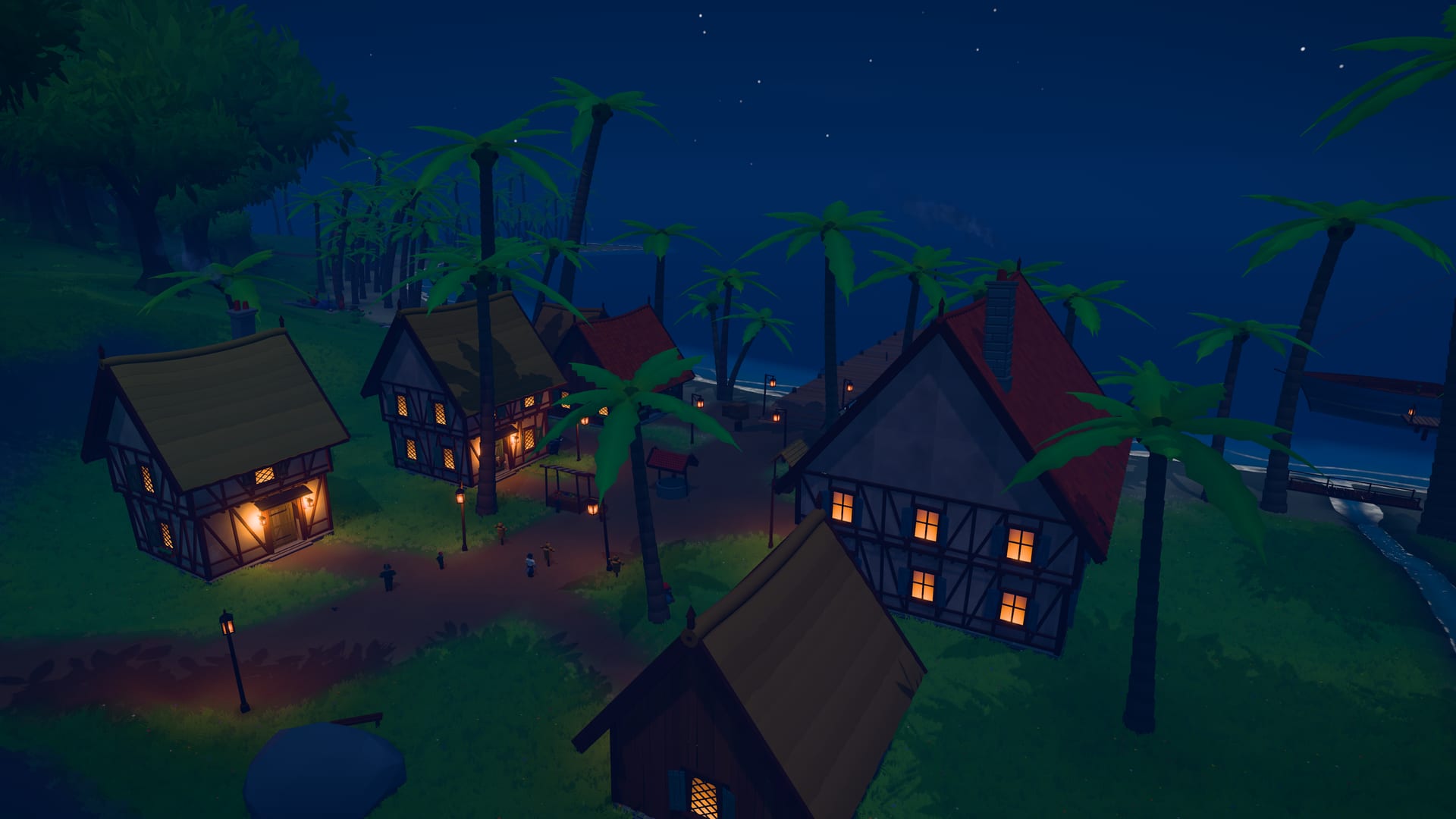
Ilvona by night
Ilvona by night.

The three powers

Three powers compete over what remains. Each holds one thing the others need to go to sea, so nobody can do without the others for long, and nobody wants to pay for them. Each has something worth defending and something to answer for.

The Crown

A monarchy. The Sovereign rules from the High Seat on Gremenolt, the largest island left, and governors rule the colonies. The Crown has the timber, iron and grain, so it builds the ships. It stands for order, law, rank and the navy: safe roads, fair weights, and a tax on everything. It sincerely believes it is the only thing between the known waters and chaos.

Its ugly side is privateers, press gangs, excise men and wreckers on its payroll. Only Ulven may hold its titles. You'll meet it at Hetern on Keitold Isle, its richest colony.
The Republic

A merchant republic. Tide Hall in Sulanni is its council, elected by the lamp-houses, the guilds and the citizens. No king has ruled in the north for two hundred and fifty years. The Republic owns no great fleet. It owns the lights and the charts: the lighthouses, tide tables, pilots and credit that everyone else steers by.

Its faith is the Old Tide, an order older than the Republic itself, which keeps the lamps, the bells and the sea's bargains. Its ugly side is tide-dues on every ship that sees a lamp, debts that last generations, and closed harbours. You'll meet it at Sulanni on Haurumo Isle.

The Brethren

The pirates, and not a state at all. The Brethren are a compact: each crew signs the Articles, which set out shares, votes and punishments, and a crew can vote its captain out. The Council of Captains meets aboard a beached man-of-war in Tongkipan. As its Speaker puts it, Tongkipan isn't a country, it's an argument that's been going on for ninety years. The Brethren have the powder, from the sulphur of the Caldera, and the rum.

They stand for freedom, equal shares and no masters, and anyone can sign. Their ugly side is that they take what they need, sell powder to anyone, and maroon their own. Both states hate them. You'll meet them at Tongkipan on Kagaru.

Each power has its own island, capital and quests, and you can work for all three. Do enough for one and it sends for you by post: swear fealty at the Citadel, take the salt at Tide Hall or sign the Articles under the Hanging Tree. The other two will remember that you did. You can change sides later, and it costs about what you'd expect.

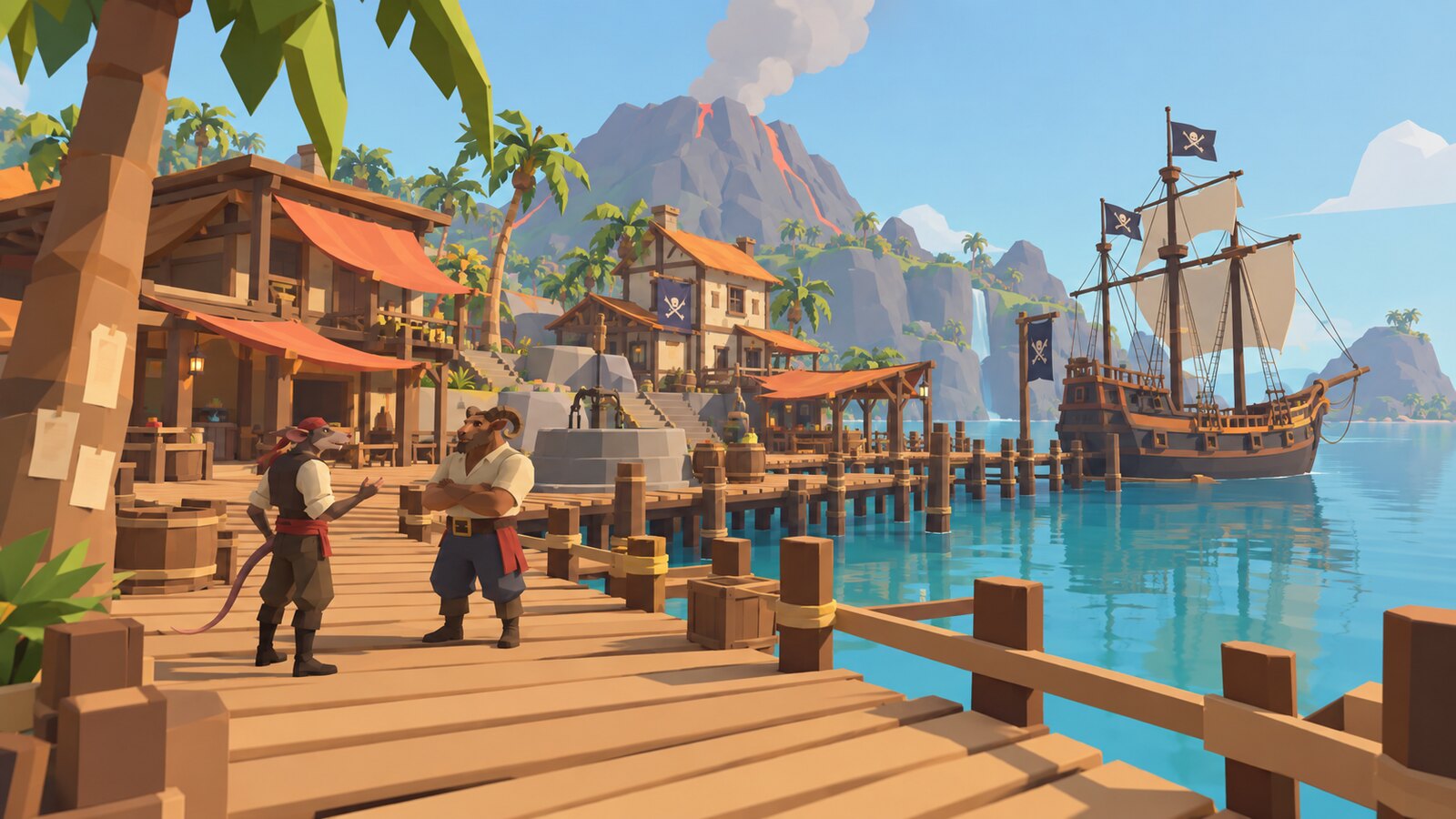
A timber harbour under a smoking volcano with palms and stilt houses; a Holdborn and a Tharr talk on the boardwalk by a moored ship
Concept art: Tongkipan.

The four peoples

Four peoples share the Wide, and all of them are animal folk: there are no humans in this world. Nobody knows where any of the four came from, and each tells its own story. They come in very different sizes: a big Morsk stands about two and a half times as tall as a small Holdborn. Any of them can serve any power and follow any path.

Each people has its own mark, a skull and crossbones of its kind. A mark belongs to a people, not to a power: a Tharr deserter sailing with the Brethren still wears the ram.

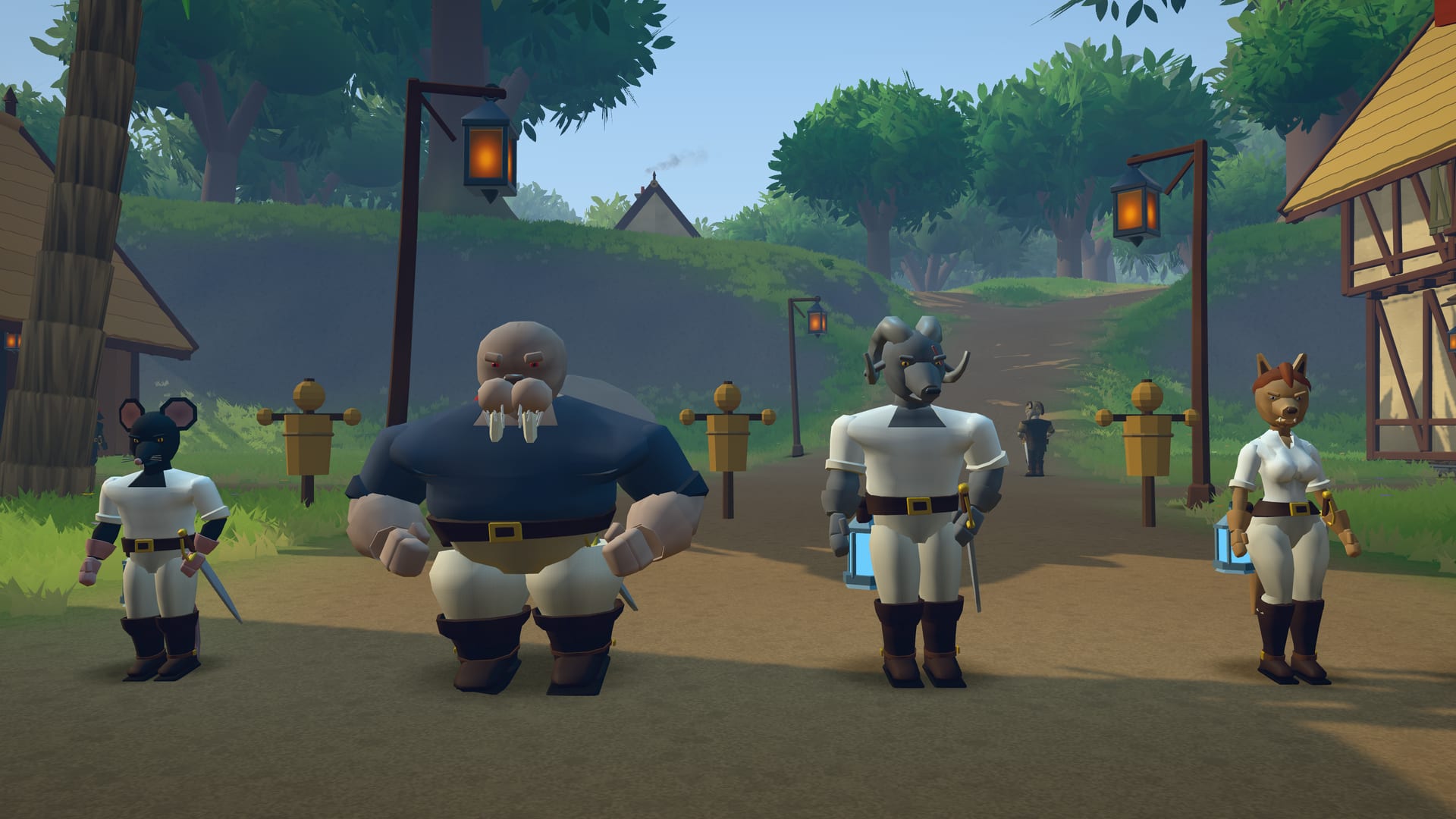
Holdborn, Morsk, Tharr and Ulven, the four peoples
Holdborn, Morsk, Tharr and Ulven, the four peoples.

Ulven, the wolf folk

“We followed the Lamp.”

They say their packs steered by the small moon to dry ground when the land drowned, and that everyone else followed them. Some say it with pride and some with shame. Rangy, sharp-eared and amber-eyed, with a brush of a tail and a mane they wear as they please, the Ulven are the most common people in every port and at home under any flag. The Crown's nobility is Ulven only.

Tharr, the ram folk

“The mountain made us.”

Horned, heavy and sure-footed, from the high peaks of Gremenolt, which were theirs before the Crown took them. They are the Crown's oldest subjects: its masons, miners and soldiers, and the most devout people in the known waters. No Tharr may hold a title. Many have deserted to the Brethren.

Morsk, the walrus folk

“The sea took us in.”

The biggest people on the Wide by a head and more: huge, tusked and thick-hided, from the cold waters north of Haurumo. They are slow ashore and graceful in the water: the Republic's pilots, divers, harpooners and salvagers. Some old Morsk walk into the sea and don't come back. The Morsk don't talk about it.

Holdborn, the rat folk

“We were always this.”

Small, lean and quick-handed, chest-high to an Ulven and half the height of a Morsk, with a bald, scarred tail. They have no homeland but ships' holds and harbour slums. Crown ports keep them to the docks and the Republic bills them double; Tongkipan lets them sign. They are known for surviving anything, fixing anything, and knives.

In the game each people is a little better at two talent branches and locked out of none. The how-to-play guide has the details.

Laws of the sea

The Ferry Truce

No ferry and no lighthouse is ever attacked. The Crown, the Republic and the Old Tide agreed it; the Brethren's Council voted for it once and has argued about it since. Ferries fly white and blue, the Truce's colours.

Harbour law

Ports are safe. Every power hangs anyone who fights in a harbour, even the Brethren, because a harbour that burns is nobody's.

Charters

Ship brokers hire out ships under each port's charter. Lose one, and the harbours remember for a while.

Satisfaction

Duels are an old custom everywhere. Blood is drawn, nobody dies, and the matter is settled.

Faith and hexes

Magic in the Wide is light, and rooted in belief and bargains. Nobody throws fireballs. Healing prayers and curses work, and nobody knows why.

Faith

Every faith has preachers who can heal: the Crown's High Altar, the Old Tide's tide-priests, the Brethren's hedge-preachers and ships' chaplains. They can't all be right, and each takes the healing as proof that it is.

Hexes

Curses tied into knots, sealed in bottles and paid for with dead men's coins: sailors' folk magic. A sea-witch will sell you a wind in a knotted cord. Hexers are feared everywhere. The Crown hangs them, the Old Tide keeps a tally of their curses, and Tongkipan shrugs and buys a wind.

Bargains

The deep answers some bargains. They always cost more than they seem to.

You: the tide-given

You wake on an Ilvona beach, half-drowned, with a name and little else. It happens all the time. The Wide gives people back: off wrecks, off drifting boats, from nowhere anyone can name. Ilvona's folk call them the tide-given. A few wash up every season, of every people, and most remember little or nothing.

Ilvona is a free harbour under the Ferry Truce, and its old custom is that whatever the sea gives back is owed a meal and a chance. Since the tide-given have no homeland, no family and no oath, all three powers keep someone by its ferry stage. A person with no past can be anyone's.

Who you were stays unknown, and the game never tells you. You are not a chosen hero. You are an ordinary traveller looking for work in a big world full of other people's history, and you can take part in it, change your loyalties, or sail your own course.

Morning in Ilvona
Morning in Ilvona.

What nobody knows

You'll find evidence in the world. You won't find an answer.

  • The Drowning. What caused it, and how long it took.
  • The Sleepers. Something lies under Haurumo Deep. Are there others, and did they have anything to do with the flood?
  • The Widow. Was she always in the sky?
  • The four peoples. Where they came from, and whether the change that made them still happens.
  • Ommaruun. Who built the Sunken Stair, and what's in the drowned harbours.
  • The Shroud. What lies past the edge of the chart.
  • The tide-given. Why the sea gives people back without their memories, and where they were before.

In the game today

The alpha covers a corner of the known waters: eight zones and twelve crew adventures, up to level 40.

Ilvona IsleWhere everyone washes ashore
1–10
Keitold, Haurumo or KagaruA power's own island
10–20
Mirrasu and the NarrowsA drowned land, a half-built bridge
20–30
Nuuralu and VenaluIce in the north, shallows in the south
30–40
Crew adventuresTwelve, for a party of four
9–38
Battles at KuramiseTwo powers, eight a side
20–25
Levels from 1 to 50. The alpha goes up to 40 for now.
IslandHeld byLevelsWhat's there
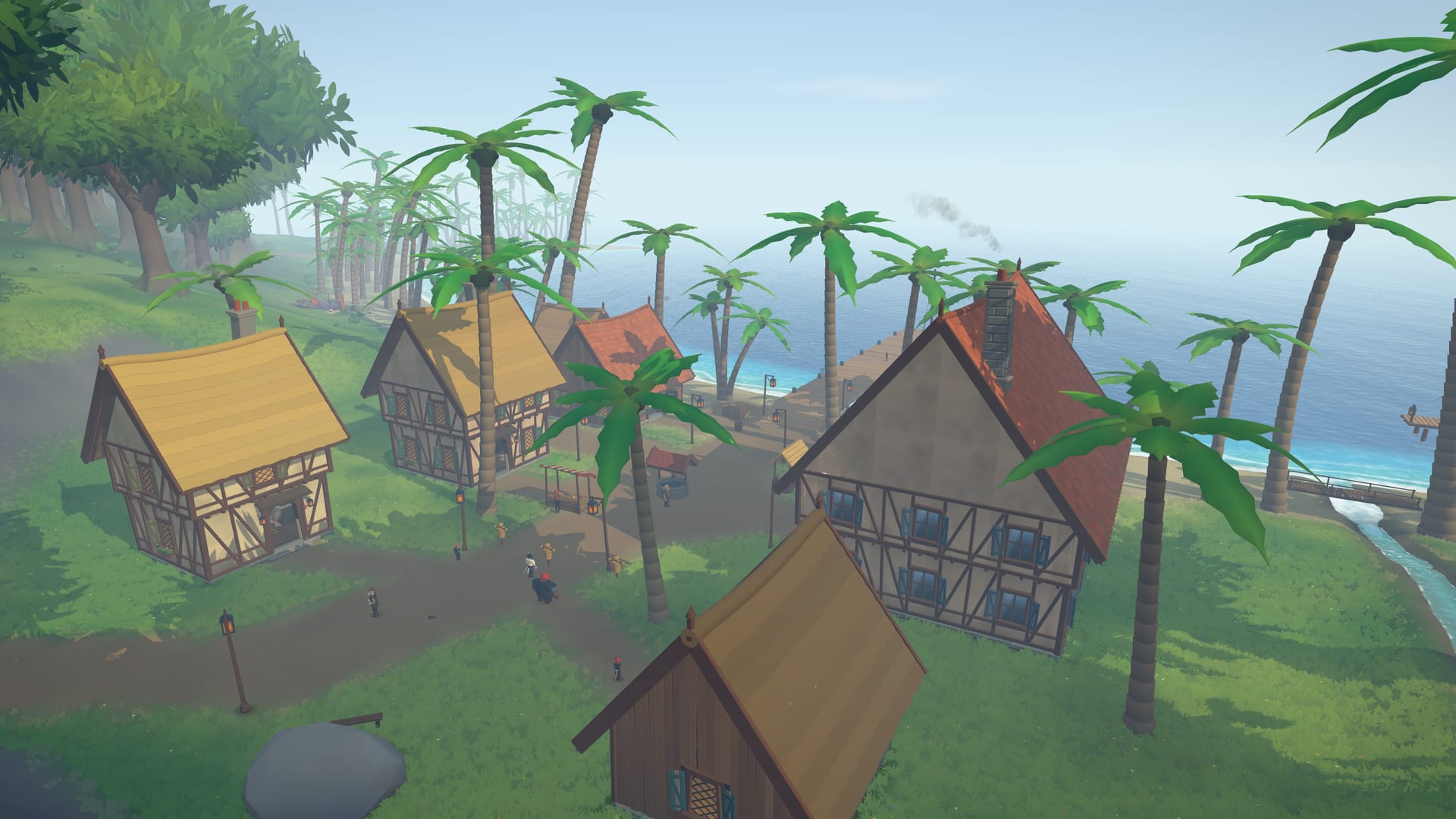
Ilvona IsleNobody: a free harbour1–10Where everyone washes ashore. A harbour village, a lighthouse, a wood full of marauders.
Keitold IsleThe Crown10–20Hetern, the Canefields, Wersch Gunnel, Glausk Fens and the ruins of Fort Natrun.
Haurumo IsleThe Republic10–20Sulanni and its Drowned Temple, the heath, the Sounding Cleft and the barrows of a drowned king.
KagaruThe Brethren10–20Tongkipan in its crater lagoon, the Emberwood, the Sunken Stair and the Caldera.
MirrasuAll three, and the Truce between them20–30Six islands over a drowned land: a landing for each power, the Truce town of Sayuni, the drowned city of the Steeples, the Bellmouth cave and Last Light Isle at the edge of the chart.
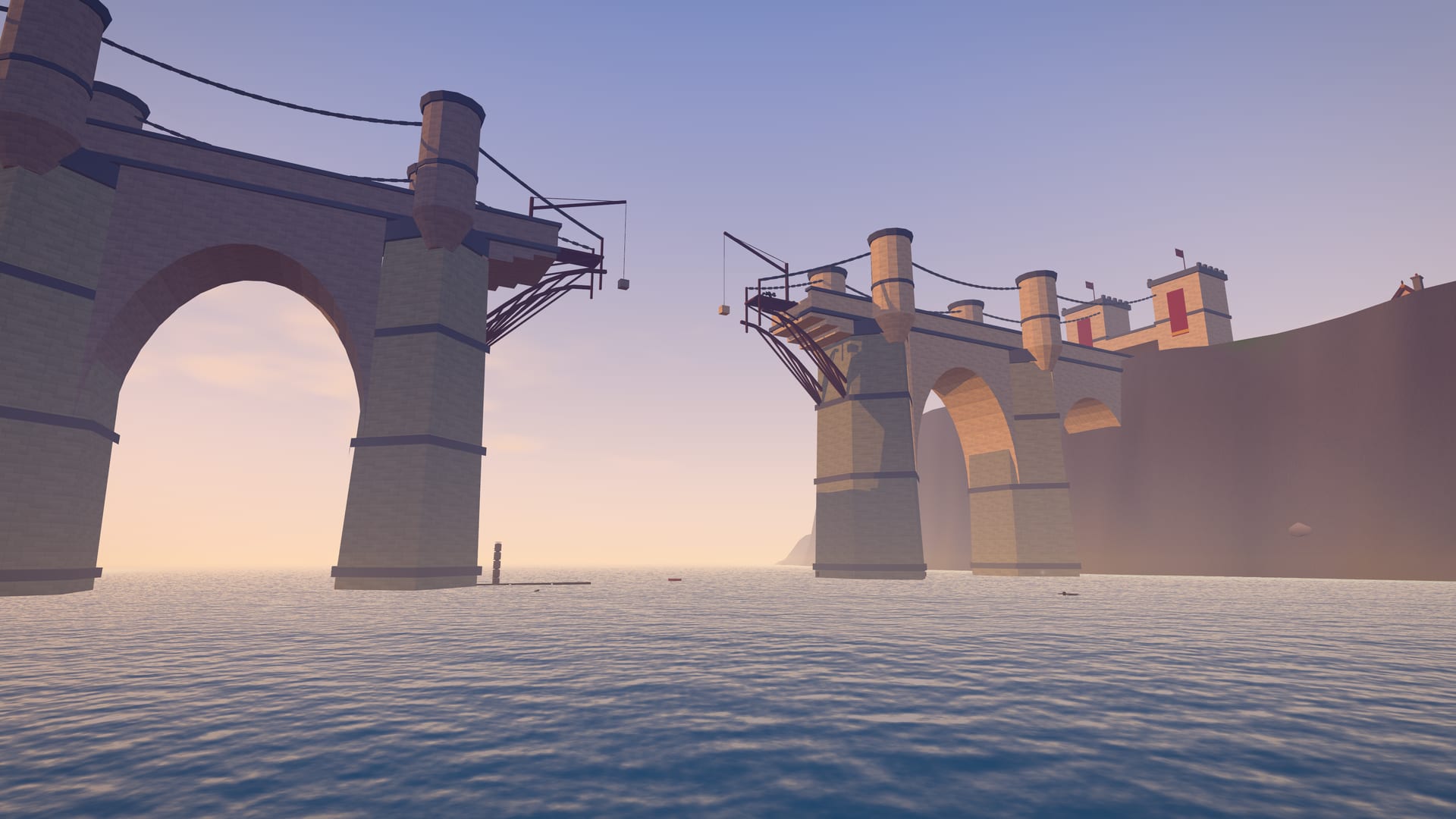
The NarrowsThe Republic and the Crown, an island each; the Brethren in outposts20–30Two islands that nearly touch, Ilmanni on the Republic's lakes and Fort Verd in the Crown's forests, and the Concord Bridge, which each is building from its own end.
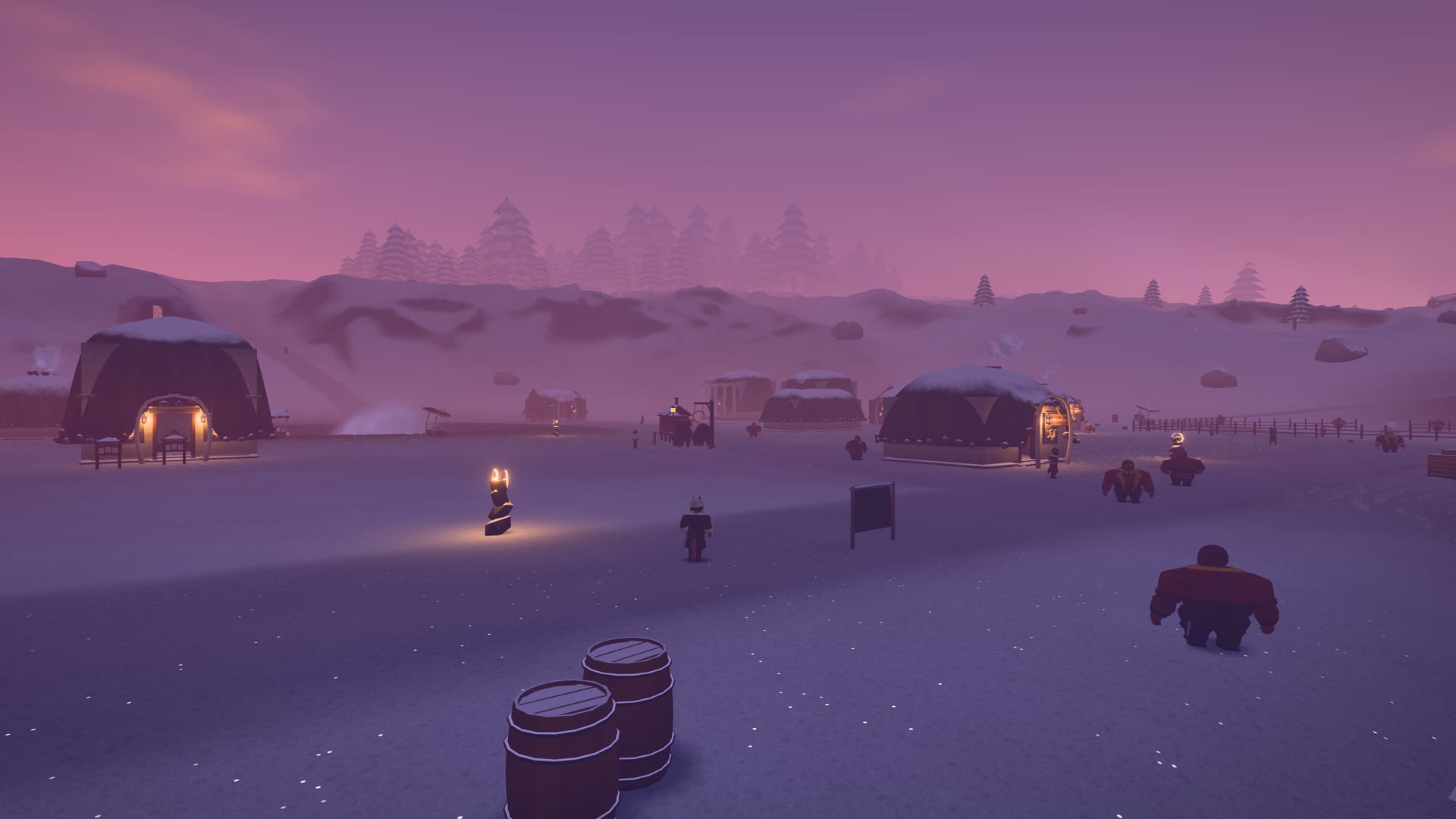
NuuraluThe Morsk' Floe Moot, with a foothold rented to each power30–40The Morsk homeland, a winter island: Oolemmu on its hot springs, Taumuun, a drowned town the glacier gave back, the High Ice and the pack ice of the North Shore.
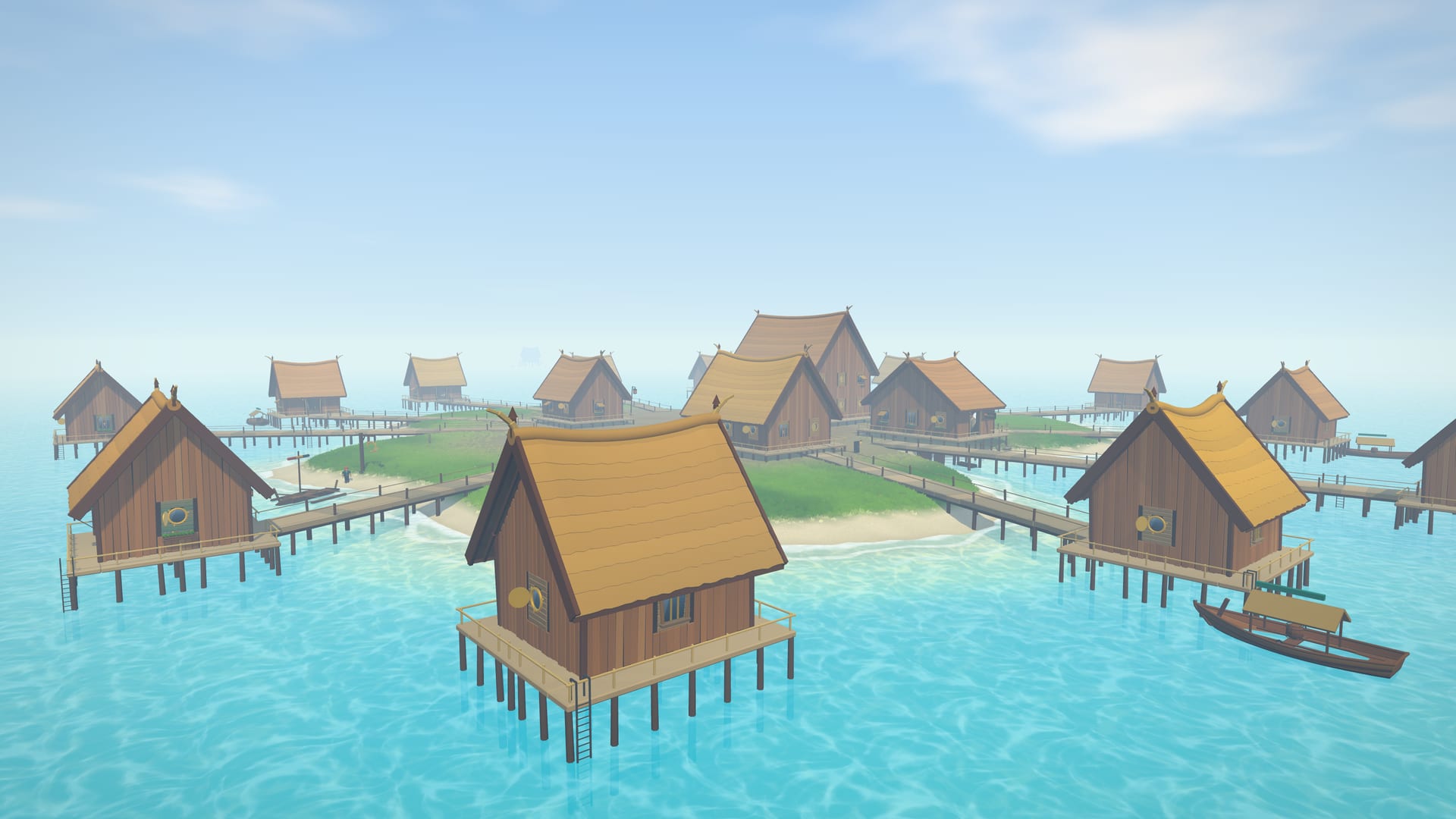
VenaluNobody: nobody owns the water30–40The Imuvai sea-nomads' shallow banks and deep channels: the floating town of Hennavi, stilt villages, the drowned city the Crown and the Republic race to strip, and Tohiri, where the ferry from Kagaru comes in.
Hennavi, the Imuvai's stilt town in the shallows
The unfinished bridge over the Narrows
Dusk over Oolemmu in the frozen north
Kaarvesto at golden hour
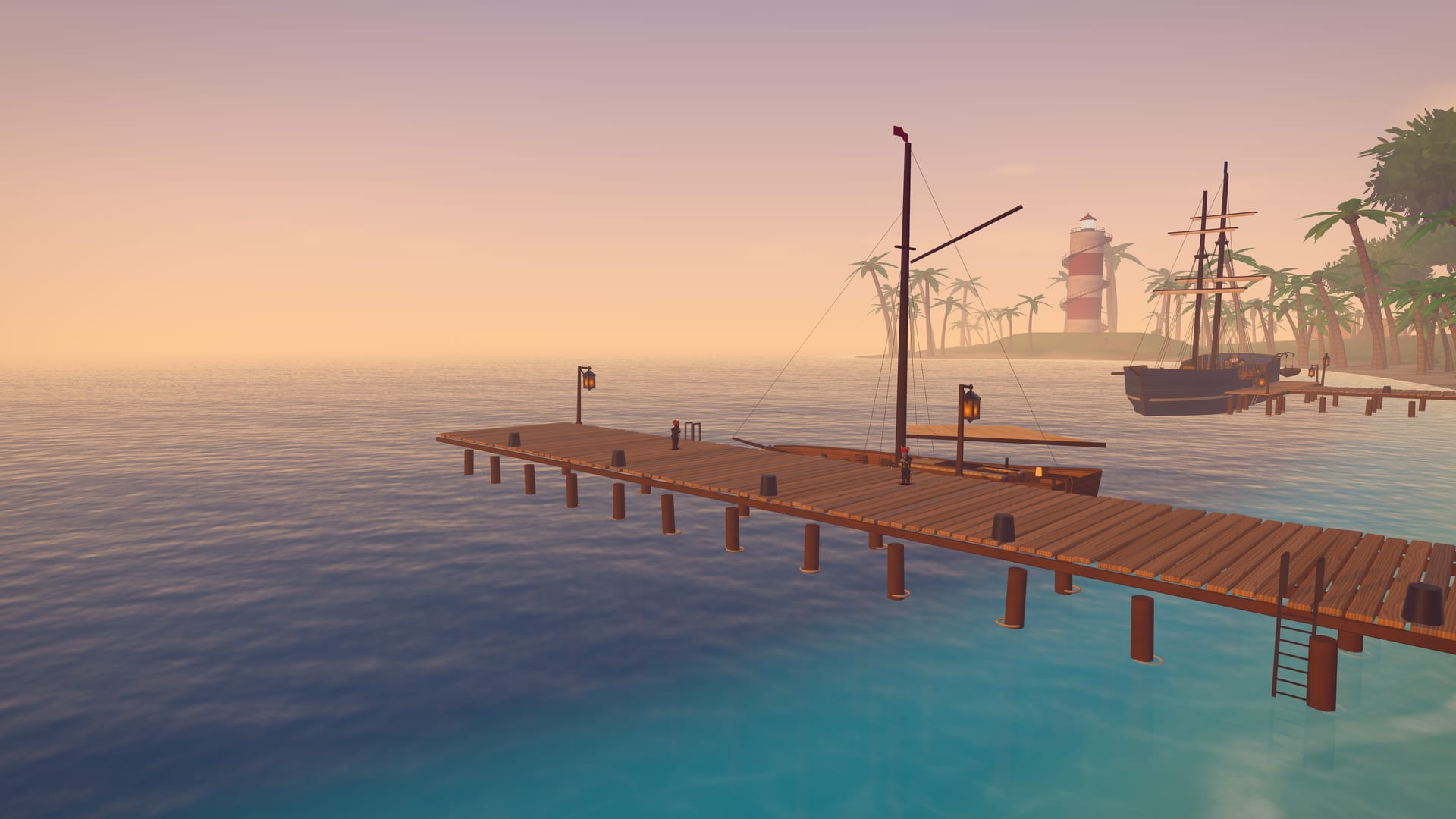
Ilvona's pier at sunset

Twice a year Kuramise, a drowned market town off Mirrasu, comes up at the Widow's lowest tide, and two powers fight over its salvage: that's the first of the Battles. Gremenolt and everything past the Shroud aren't in the game yet. New to it? Start with how to play.